
Former Premier John Brumby on Leadership & Learning in the Age of AI

The odyssey of the Hon. John Brumby AO: from classrooms to cabinet rooms to campus… and a tram ride turned AI & Us interview
It’s not every night you find yourself on a tram talking politics with a former Premier and member of the Hawke Government to boot. But such was my good fortune when I opted for public transport to an Air gig in Melbourne last summer.
Fellow traveller the Hon. John Brumby AO was aboard, en route to his own gathering (with leading thinkers in higher education rather than a French electro-pop duo), and I couldn’t help but accost him for a chat.
Evidently still a man of the people, John was happy to forego his reading and converse amiably as the stops sailed by. Happily, he also agreed to a more formal interview at a later date – this time, on the ways AI is reshaping life and work as we know it.
So, here it now is.
In this follow-up conversation, we take a trip through John’s early career in education, his decades in public office, the changing nature of leadership, and the transformative impact of technology on political life, media, business and higher education.
We also revisit some of the key themes outlined in his recent book, A Better Australia, which explores the often elusive ingredients that make for effective public policy and lasting, positive reform.
With his odyssey from classrooms to cabinet rooms to business leadership to his current role as Chancellor of La Trobe University, the Hon. John Brumby AO draws on an extraordinary wealth of experience when reflecting on big-picture change and challenges past, present and future.
Sometimes it really does pay to catch public transport…
In this conversation:
Shauna: So, John, you began your professional life as a secondary school teacher in regional Victoria but went on to serve in federal and state parliaments for three decades. What first attracted you to public life?
John: I originally studied commerce at Melbourne University but wasn't really clear about what I wanted to do afterwards. So, I ended up doing a Diploma of Education, which proved to be one of the best things I ever did.
The Education Department sent me off to my first job in Eaglehawk in 1976, which at the time was a very poor former gold mining area of Bendigo that had a chronically underfunded school with 24 portable classrooms and a huge number of first-year-out teachers. On my first day, the head of the commerce department took me aside and said, "I can tell you're going to be a good teacher. Can I give you some advice? Resign today. Get out of Eaglehawk.”
Fortunately, I ignored that advice and my time there turned out to be a wonderful experience for me. It was the challenge of education writ large, where you really saw the opportunities that education can provide.
Over the course of four years with really dedicated colleagues, we rewrote curriculum, got children involved in sports, and transformed the lives of many students.
I also got involved in the local community – joining the teachers’ union, becoming regional president, and also helping to set up Australia’s first regional Amnesty International group (prompting the local RSL to label us ‘communist sympathisers’!), and joining the Labor Party in 1978.
All of that came together to really get me very interested in change, in community, and of course, in politics. In short, in public life.
The Political Path: Now and Then
Shauna: Your career path took you from Bendigo to Bob Hawke's Federal Government in the 1980s, then to Victorian Parliament throughout the 1990s and 2000s where you held key portfolios and ultimately served as Treasurer and Premier.
In the decades since, we've seen a massive shift across social, political and media landscapes with the rise of the 24/7 news cycle, the advent of social media, and growing public distrust fuelled by endless misinformation. When you think about your time in office and the vagaries of public life today, do you see any threads of continuity? Or has the nature of political life and leadership fundamentally changed?
John: The first observation I'd make is that we haven't really seen, on either side of politics, a leader with the charisma of a Bob Hawke.
And so it's very hard to tell… if Bob Hawke was around today, would he be managing all of the social media and all of the intricacies of that? I suspect the truth is that he would be able to weave a way through it.
Shauna: He would definitely not be short of content – patriotic fashions and captivating quotes galore!
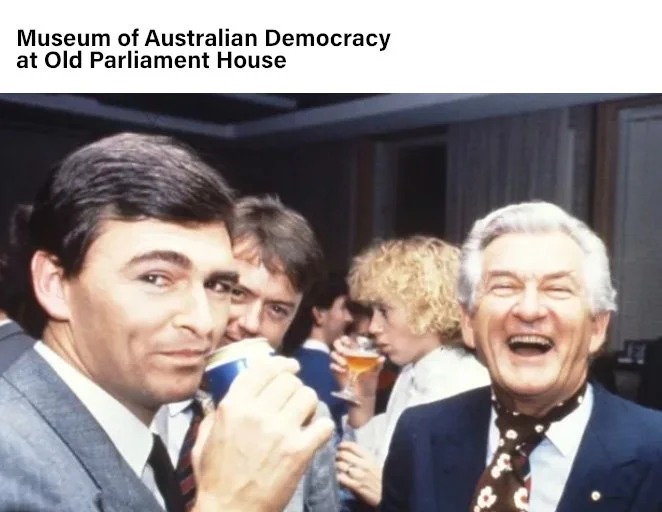
Way before there were influencers… there was Bob Hawke.
Here, John shares a celebratory beer with Prime Minister Bob Hawke (yes, the one in that eye-catching tie) to mark the last days of Canberra's Old Parliament House in 1988.
Photo by Robert McFarlane and story 'We're gonna party like it's 1988' courtesy of the Museum of Australian Democracy.
John: That’s right. But overall having said that, the landscape really has changed significantly. It's a much more challenging environment for a political leader because of the constancy and relentless nature of the news cycle and social media feeds.
In the Hawke era there was only one real news issue for the day, and the agenda was set. So, a physical copy of any ministerial speech was typed out and put in the Canberra press gallery pigeonholes and that provided the content for the news story of the day. Hansard was printed daily, and you’d get a summary of all of the ministers’ speeches and media releases stapled together. How the media has changed!
With today’s news cycle and social media dominance: what's true, what's not true? How do you tell the difference?
And from a political party perspective, the challenge is finding a way to cut through in this much more congested media environment. You can see leaders – Donald Trump being the most obvious example – that attract support and attention because they get cut-through. It’s not because he’s a genius or delivers an eloquent speech, but because of the way he presents and uses short and simple phrases.
So, politicians of all stripes are looking for more of this kind of cut-through. And in turn, I think that's leading to over-simplifying, over-promising and a little bit of over-egging what particular government initiatives can deliver or achieve in reality.
All this feeds into the growing distrust of government. Trust has been steadily declining really ever since the days of Bob Hawke and John Howard. It isn’t unique to Australia, and it goes beyond politics.
It’s consistent with the lack of trust we're seeing in other institutions, whether it's churches or universities or scientific bodies. That all links in with just how much social media has changed societal perceptions and norms. Compounding that, there’s much less scrutiny and, perhaps appetite to uncover or understand what’s true and what's not.
Leadership Now: Swapping Speeches for Soundbites?
Shauna: Do you think this somewhat grim picture will be exacerbated as AI becomes more embedded? For example, if we all get used to asking Chat GPT or Claude for all our answers, how do we encourage more informed civic debate where a broad range of ideas, trusted sources and diverse contributors are in the mix?
John: As I see it there's a really important job for what I would call the mainstream, regulated media, but it itself has become more stratified and divided.
Shauna: It's also under constant attack, for example with Trump constantly denouncing 'fake news journalists' as enemies of the state in the US. Young people opt for social over legacy media entirely, and the era of thoughtful analysis of political speeches seems a thing of the past.
John: Yes, that's a personal disappointment for me, because I always think you go back to the great speeches of Whitlam, Hawke and Julia Gillard to name a few. Great policy speeches. It’s terrible to have to say it, but those days are pretty much gone.
Media-wise, people now are just more comfortable within their own comfort zone within an aligned social media platform or an established media outlet that reflects back their personal values and views. And so, you get this sort of mutual reinforcement or echo chamber effect that plays to and reinforces people's values and prejudices. So social media has become even more important in political campaigns.
Even back in 2010 when I was still in politics, social media barely existed. We had one person on social media in my office. The rest were all on regular media. Just such a rapid shift in the last decade, and now we come to AI which is obviously set to transform political and social life in ways we can’t yet predict.
AI at Work: Strategy, Impact and Early Insights
I work with business and chair a lot of organisations now, and so needless to say, I'm seeing AI much, much more. It’s already shaping how organisations organise and strategise.
For example, we recently had a strategy day at the Melbourne Convention and Exhibition Centre, and our facilitator fed 80 documents that we’d produced over the last three years into ChatGPT, and we could draw on that to inform our discussions.
So, I’m seeing it more and more, with colleagues using it to check their emails have the right tone and law firms using it to prepare cases for example. It still requires a lot of oversight and checking for accuracy of course, but you can really see how it is changing the nature of work, communication and efficiency already.
Shauna: What about in the world of education? You’re now Chancellor of La Trobe University, which has a real focus on helping regional and rural students access tertiary studies. Do you see AI as a game-changer in terms of equity? It obviously has untold implications for educators, current and future.
John: As I see it, there are two ways AI could hypothetically help. The first would be to help us develop better strategies for providing targeted assistance and resources for students from different backgrounds and diverse learning styles.
And also, in terms of our Pathways program, we can look at the data and find new ways to understand whether we’re targeting prospective students properly and identifying the right cohorts with the right resources.
But when it comes to equity and AI more broadly, we need to recognise that the data many of these systems are being trained on doesn’t reflect all of society, and that can entrench bias.
In the context of higher education, a key question for me is how AI can help and support the students. In my mind, we need to empower students and teach them about AI’s capabilities and uses.
Basically, how can it serve as a tool to help you? Not to cheat of course, but to provide learning support and improve your academic performance through effective tools and applications.
AI and Education: Help or Hindrance?
Shauna: Cheating is such a huge issue now though, isn’t it? Having seen education from all sides – as a student, a school teacher, a teachers' union representative, and now as a leader in higher education – what do you make of the fact that we can now all just get ChatGPT to do our essays, assignments and research work that once demanded real, challenging and sustained intellectual effort? Which ultimately is what helps us master certain skills and become genuinely knowledgeable.
John: It’s a really big problem, and again there are two sides to it. On one hand, AI is the ultimate individualised learning tool. It’s something we dreamed about decades ago. Back then, education theory was in its embryonic stages, but individualised learning was basically about how you set clear objectives for a student. You’d be collecting the right materials in the form of overhead slides and cassette tapes, and the goal was always the same: to tailor learning and support each student’s success.
I've still got an old yellow folder at home with my sort of thesis on my best learning package from back in the day as I was so proud of it. AI can now deliver all that and more almost instantly now, so it’s like that learning package dream come true. It's nirvana.
AI will provide all the best learning tools and resources at the click of a button. But it also opens up that temptation to cut corners and have it do the hard work for you. And that is a serious concern.
So, in turn, you're seeing universities invest a lot of money in software and intelligence that picks up cheating. For instance, Melbourne University has a program called Cadmus, which is very clever at identifying AI-generated content.
But my personal view is that we will need to move to more individualised and perhaps even more handwritten assessments, to make sure that students have actually learned what they need to.
I know that’s somewhat paradoxical though and I think universities will be, and are, reluctant to go down this path, but I'm big on the face-to-face learning. I really am.
Hybrid models, with a mix of online and in-person teaching, are favoured at the moment and can work well. But the reality is that universities, like schools, are still grappling with cohorts of students who are largely at home and often disengaged. Many of them experienced online learning during COVID and never fully reconnected with traditional study methods. By the time they reach university, if they haven’t had a solid grounding in primary and secondary school, it’s hard to catch up.
A lot of students simply haven’t developed the basic study skills. It’s a significant issue, and one we can’t afford to ignore. So, face to face needs to be part of the picture, whatever the technological landscape is offering us.
AI Regulation: Can Australia Lead – or Even Play a Part?
John: We also need to be thinking about questions around protecting vulnerable groups, especially children. Every child I know, including my grandkids, knows how to use a phone. But all that data is being harvested. The advertising algorithms know what you’re interested in and even what you’ve been talking about. That’s why we need proper regulation to protect people from surveillance and manipulation.
Grahame Samuel, the former ACCC Commissioner, is strong on this. He’s very market-oriented, but he says: get the regulatory settings right, then let the market work. But you need to move quickly. AI is rolling out fast.
Shauna: It is. And in your latest book you argue that "states and nations do well when they get out in front of massive global trends."
In the AI context, we saw France playing a leading role earlier this year hosting a global AI Action Summit that Australia attended, joining 60 countries in signing the summit Statement on Inclusive and Sustainable Artificial Intelligence.
So, we might be participating in international forums which is great, but the issue barely registers in our domestic political debates. Do you see an opportunity for Australia to take a more proactive role in shaping AI governance, rather than waiting to see what plays out elsewhere?
John: At the outset, I should say that I think the Albanese Government’s legislation to ban social media for under 16s is excellent public policy, and strong and effective social policy.
But at a more general level, I’ve formed the view – fairly or unfairly – that Australia did once have a leadership position in lots of global issues but really hasn't done so in the same way for some time.
So, I don't have a high degree of confidence that we want to be seen as necessarily having the ability to be a leader. But still, this is a perfect example of the sort of Australia that we might envision.
You know, as a small country by population, about 1% of the world's GDP, and not tied to any particular other country globally – and with a degree of independence in our core thinking and foreign policy – we could focus on becoming a leader in new areas.
But I'm not sure we've got the inclination or the ability to do that at this point in time.
Looking Ahead: Optimism, Pessimism and Timeless Political Wisdom
Shauna: And just to wrap up, if you had to sum up your outlook on AI and humanity’s future in one word, what would it be?
John: In my book, I took an optimistic view – and I think I’ve got to stick with that. I’m still optimistic. But it comes with caveats.
If I was taking a more pessimistic view, I think of that early 1990s Arnie Schwarzenegger movie Total Recall where people lived in this futuristic world where they didn’t have to deal with reality.
In the same way in our future lots of folk might think lying around all day with your 3D goggles on, chatting to an AI bot might feel safer, more exciting than the actual real world around them. The thinking might go that they won't have to work hard, they won't have to lift bricks in the sun, they won't have to do a job for 40 hours a week. They don't have to put up with somebody telling them what to do.
But that raises unavoidably hard questions in reality – about work, purpose, connection and the need for a universal basic income for starters. Perhaps there’s a generational dimension to that too. If you’ve grown up staring at a screen, that version of the world might be more appealing.
But going back to my more optimistic thoughts: preventative health, smart tools, learning support, time-saving tech. AI could help us perform better and live more freely. The hard part is getting the balance right.
Ultimately it comes back to some advice I was given on my first day in the Australian Parliament over four decades ago. I sat down next to the former Deputy Speaker, who'd been there over 15 years, so he knew a thing or two.
'John,' he said, 'it's a cliché, but I'll tell you anyway.
'Up here you'll see a lot of complex problems and someone will always say, "Oh, but there's a simple solution."' And then he added: 'But it will always be wrong, because the truth is there are no simple answers to complex problems.'
Well, at least on that front, it seems the more things change, the more they stay the same.
I’m a freelance writer/strategist who shares complex concepts, ideas and insights along with stories from the extraordinary people behind them. If you’d like to work together, contact me.
