
Beyond chatbots and agents: why it’s the ‘boring middle’ that’s actually reshaping knowledge work
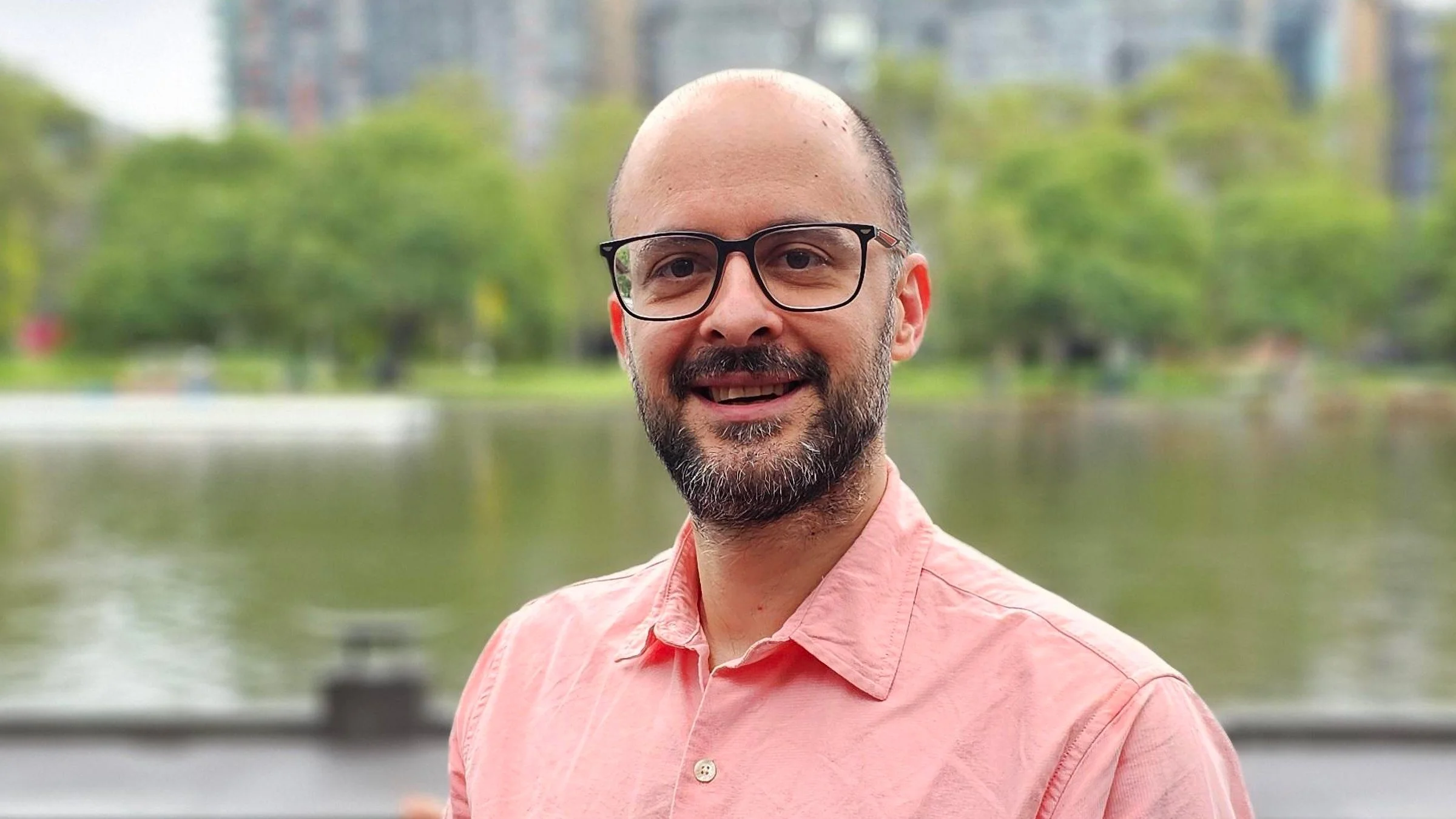
'In times of transition like this one, the right path almost always appears to be the wrong one' — Theodore Galanos on why workflows, not chatbots or agents, will determine the future of knowledge work.
In a few short years, AI tools like ChatGPT, Copilot and Claude have shifted from novel curiosities to familiar companions. Whether at home or in the office, millions globally now rely on chatbots to complete daily work tasks and even navigate the most basic aspects of life.
This rapid if uneven uptake has coincided with a rise in bold but often abstract predictions about AI taking jobs and transforming entire industries in no time. In construction and engineering these forecasts are many, though examples of radical change remain few.
Given chatbots are the only form of AI most of us yet know firsthand, it’s not surprising that workplace conversations and even recent industry analysis tends to focus on ‘quick wins’: time saved on emails, financial reporting and meeting transcriptions that might make room for more complex or creative work. While welcome and useful, it’s hard to see how this might add up to any kind of revolution, on or off site.
To find out what’s missing from this picture, I sat down with Theodore Galanos, Generative AI Leader at Aurecon and Chief Science Officer at Infrared.city. With a background that combines mechanical engineering, industrial ecology and close collaboration with global communities like Eleuther AI, Theodore has a rare ability to translate what’s coming next in AI for people working outside it.
‘It’s a real time of transition and people are currently being pulled in two directions,' Theodore begins. 'One from the past, which is the chatbot and one from the future, which is agents. Everything rotates around those two technologies at the moment, so it’s easy to lose sight of what’s in the middle.’
‘But that’s where the difference between using AI and being transformed by it lies: in workflows and orchestration. This middle layer might sound boring compared to the worlds of chatbots and agents, but it actually holds the key to unlocking human potential at scale. And that's the future of knowledge work.’
Fact vs fiction: the current state of AI inside industries today
Before casting ahead to the future, Theodore starts with a snapshot of what he calls the ‘sobering reality’ of the current landscape.
‘While we do see “AI-exposed” industries showing significant productivity growth, only 22% of companies have really moved beyond proof-of-concept,’ Theodore says.
‘The majority of organisations are stuck at level one – giving employees access to ChatGPT, building simple retrieval systems or creating isolated tools that can lead to linear improvements: people are 10% more productive here or 20% of time is saved there.’
‘Meanwhile Frontier Firms – an elite 4% of all organisations – are operating at a different level entirely. They're not just using AI; they're restructuring around it. These firms stand apart because they recognise systemic transformation beats incremental improvement every time.’
‘Put simply, it’s not about making individual professionals more productive. It's about reshaping how knowledge work itself operates.’
‘As Aurecon CEO Louise Adams recently said, we’ve entered the ‘age of the engineer’. It’s a time when we have more knowledge than ever, but the expertise we need to apply that knowledge effectively in practice remains desperately scarce. So what we most need are complex problem-solvers at scale. In other words, we need workflows and orchestration.’
What is workflow orchestration and why does it matter?
‘Every organisation we work with faces the same paradox,’ Theodore says. ‘They have terabytes of documentation, thousands of precedents and decades of accumulated knowledge. But when a complex problem lands on their desk, they scramble to find the one or two senior experts who can make sense of it all. This is the expertise bottleneck, and it's getting worse.’
Construction disputes are a prime example of this. A single major project can generate more than 100,000 documents that collectively hold the answers to critical questions about who made agreements and what caused delays, but who has the time and expertise to uncover them?
‘We know this information exists, but to identify genuine insights senior professionals with decades of experience need to spend time synthesising across multiple areas, spotting patterns and finding answers from fragmentary evidence. These experts are usually rare, expensive and overwhelmed with work.’
This is the constraint AI workflows and orchestration are designed to break. Rather than replacing expertise, the idea is to systematise and amplify it. Domain experts design the workflows themselves – encoding the analytical logic, decision criteria and quality checks they already use.
Orchestration is the layer that connects different tools and workflows to make them operate as a system. It determines which workflows run, in what order, what dependencies are and how outputs are combined. The goal is not to simplify complex work, but to amplify expert judgement.
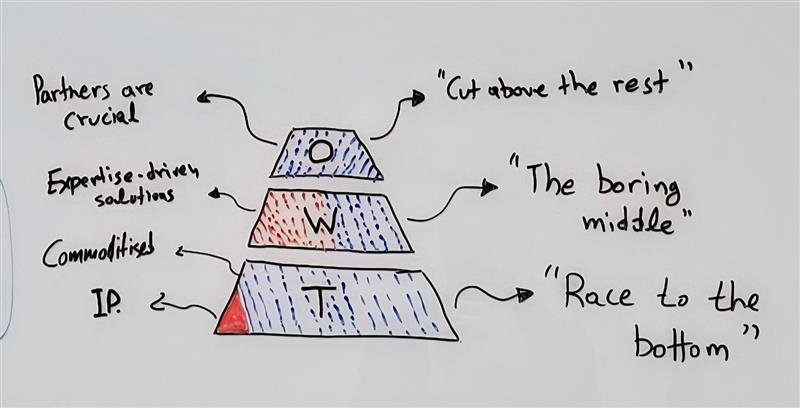
‘Everyone wants to jump from tools to agents,’ Theodore says, sketching out this drawing to convey the concept. ‘Nobody wants to build the harness. But this ‘boring middle’ - encoding expertise into structured workflows - is the part that makes everything above it work.’
‘If tools are the engine and agents are the vehicle, workflows are the transportation network. Workflows give purpose and direction to agents and their tools, defining valuable problems and approaches to solving them.’
‘This takes us from scarcity to abundance,’ Theo says. ‘Because traditionally, expertise has been scarce and localised. One senior expert tackles one complex problem at a time. Junior staff wait for review. Knowledge transfer is slow and uneven, and when experienced people leave, much of what they know leaves with them.’
‘Take a complex construction dispute involving tens of thousands of emails, reports and meeting records across contractors, subcontractors, clients and authorities for example. This might require around 40 hours of senior expert time: reading documents, building timelines, analysing causation, checking agreements, identifying patterns. That's one expert, one project, one week.’
‘With orchestration, work is broken into focused workflows — each designed to answer a specific question, such as who caused a delay, whether an agreement was reached, or whether similar situations had occurred before.’
‘In our work at Aurecon we’ve shown this now takes 4-6 hours of combined human time, mostly involving review and judgment. The senior expert can handle 8-10 such matters in the same week. Their expertise is effectively multiplied by ten.’
‘The real transformation isn't the time saving. It's what becomes possible when expertise is no longer the constraint.’
And as Theodore’s articles and case studies highlight, this goes well beyond theory or contract disputes.
‘Think of a design review on a sprinkler system for instance. I won’t understand what that particular system is or what it involves, but our engineering experts do. So they design the review guidelines, the logic and even the systems of software required to execute it. And our AI team orchestrates that with them.'
‘In this way we encode expertise into specialised AI workflows for problems experts can delineate, describe and know how to solve. We’re already seeing organisations building these kinds of specialised workflows across legal, financial, operations and commercial areas. Each workflow encodes years of domain expertise and can deliver real answers instead of information dumps.’
Out of distribution: understanding why AI still struggles with engineering
Given AI’s rapid advance, it’s almost surprising to hear that complex knowledge work like engineering will continue to rely so heavily on expert human judgement. I ask Theo why models can’t simply learn from drawings, documents and calculations, then take it from there. Because we’re so often told that thanks to AI humans will become either superfluous or maybe just bit players ‘in the loop’.
‘I think this concept of "humans-in-the-loop" really reveals our backwards thinking about human-AI collaboration,’ he says. ‘We hear that phrase more and more but it has always bothered me because it implies humans are passive validators – like quality checkers on an AI assembly line.’
‘This framing is not just wrong; it's dangerous. It leads to systems where humans rubber-stamp AI decisions they don't understand. Where expertise becomes atrophied rather than amplified and where we optimise for automation rather than augmentation.’
Theodore argues that we need to flip this mental model completely.
'What we actually want is humans driving the loop,' he says. ‘If you design the workflow properly, you can embed verification into it. This approach also helps ensure expertise and skills don't atrophy over time. Instead, people can often sharpen their thinking and problem solving through this process, rather than potentially losing skills by consistently delegating this kind of work.’
‘And as to the bigger picture when it comes to AI and engineering specifically, what we’ve really been expecting to happen, hasn’t happened yet,’ Theodore says. ‘With AI there’s something called distribution and you’re either in or out. Engineering is not yet in distribution.'
'By that I mean models that don’t just scan and summarise, but actually understand and interact with the core aspects of engineering work. They don’t yet have a meaningful and multimodal understanding of engineering and construction. '
'For example, even if you use the strongest model and ask it something about engineering, and you’re like me ‘pretending’ to be an engineer, you’ll think look at what the model comes back with and think ‘wow, that’s amazing!’.
'But if you’re an actual expert engineer, that’s not the case. You’ll find a number of things you’d never write or do. So models ‘kind of’ know engineering, but don’t actually know engineering. If as a user you don’t know the domain, you’re likely to think it’s correct. And that’s very dangerous.'
‘It’s the same in verticals like law and architecture. Coding is the only task in the world right now that’s in distribution. There was an interesting discussion with OpenAI co-founder Ilya Sutskever recently that highlighted this problem that many of us recognise now. The singular focus on coding has been a real blind side in AI.’
‘So from the beginning, the idea was that if we had a model that was superhuman at coding and maths, it would just generalise beyond the world of coding and into other verticals. It was a solid idea, but it turns out that’s not happening.'
‘A lot of engineering is not calculations. It requires understanding, in both a visual and multimodal way, of why things are not in the right place. These kinds of tasks are very simple for humans, but very hard for current models. That’s why you need to embed expertise directly: tell the model what not to do, define the boundaries of what it doesn’t know, and make explicit the order of operations, checks, guidelines and logic an expert already follows.’
‘We need task-specific data. Think of a Word document. Fifty people collaborate. Comments everywhere. What do we keep? The final version. All that history of collaboration is gone. From a model’s point of view, that missing history is everything — understanding both what to do and what not to do, what changed, what failed, and why something was rejected.’
The Tipping Point Counterfactual: Why Workflows Are the Real Bet
Looking ahead, Theodore is clear about what will define AI’s trajectory in the near future and it goes well beyond chatting to chatbots.
‘Ultimately, we’re at a tipping point,’ Theodore concludes. ‘Times of transition are always characterised by counterfactuals, where the right path and the right moves forward almost always appear to be the wrong ones.’
‘Right now, the focus is on agents and chatbots, while AI workflows are treated as a “nice-to-have” add-on or some cool technology that might earn reputation points on the next big project. But this seemingly unimportant technology and way of thinking is actually the bet to take today.’
‘That’s the counterfactual that matters most. Because in the next year, I think almost all valuable work will happen within AI workflows. The organisations solving orchestration today are set to define the future of industry transformation tomorrow.’
In the months ahead, we’ll be exploring the other side of what Theodore describes as the autonomy coin: workflows on one side, skills on the other. If workflows are structured and prescribed, skills are more autonomous and adaptable beyond a fixed sequence of steps.
Another big question is: what are the deep thinking and problem-solving skills we’ll most need, and how do we build them for future workplaces and tasks that as yet, seem great unknowns. Theodore is set to share his latest thinking on that in Part Two of this series later in the year.
For more on Theodore’s work:
For more on AI and engineering:
As a freelance writer/strategist, I share complex concepts, ideas and insights along with stories from the extraordinary people behind them.
If you’re interested in working together, feel free to contact me.
