
Tony Wright on the Craft of Journalism Past, Present and Future

Tony Wright works away among his treasured books and papers that only just survived the digital transformation of newsrooms. Photo by Justin McManus courtesy of The Age
Walkley Award-winning journalist Tony Wright ‘started on a beaten-up typewriter in the age of ink’ and has been charting a rapidly changing world ever since. Over the past five decades, he’s covered some of the most consequential events of the late 20th and early 21st centuries, including the demise of the Soviet Union, the fall of the Berlin Wall and genocide in Rwanda.
Closer to home, Tony has shared insights and analysis throughout countless state and federal election campaigns – and chronicled the hijinks and hubris of political players of all stripes, like no other. He often looks past the usual suspects to uncover the truth of things, preferring vignettes about lives and deaths beyond the public spotlight as a way of illuminating what it is to be human, and the struggles and small victories we all share.
Put simply, Tony is a master of the craft of journalism. His inimitable style weaves essential facts and figures together with human stories and historical threads drawn from across the ages. He has kept readers of The Age, Sydney Morning Herald, Bulletin, Canberra Times and countless country newspapers informed, engaged and highly entertained for over 50 years, and continues to contribute as an associate editor and special writer for The Age and Sydney Morning Herald today.
This week, I asked Tony to share his thoughts on the past, present and future of journalism in the age of artificial intelligence. Will AI fundamentally alter the craft of writing? And who will pay to create, sustain and source journalism of substance and sentience? In a search for some answers to these and other tricky questions, Tony characteristically looks to history and human nature for hints as to what comes next.

Young Tony Wright sporting a glorious mane in 1979. (Photo courtesy of The Age)
Shauna: So Tony, you filed your first news story at age 15 – having beaten ‘hard-bitten big-city reporters’ to an audacious midnight maritime scoop. You’ve been on the scene sharing tales of people from all walks of life ever since. Do you see this kind of storytelling as the essence of good journalism?
Tony: Well, yes that’s what I see. Of course everyone does things differently, and I’m from a particular period I suppose. I was something of a school-holiday freelancer for my small country paper, then became a journalist in 1970. But I didn’t twig to this idea straightaway that talking to people was quite simply what it was all about. For example, as a fairly young journalist of 21, I got this gig with an afternoon paper called the Canberra News. My job was to arrive at Canberra Airport (which was little more than a shed in those days) before dawn and interview all those who landed – the idea being that I’d fill page two with interesting stories by 11 o’clock. So, I’d chase the politicians and senior public servants for stories, but the truth was I was failing at it. Very dramatically.
One day, this old-time war journalist looked at me and said: ‘It’s not working really, is it?’. I said, ‘No it's not. It's really not.’ And thankfully, he offered me some much-needed advice. ‘Instead of trying to buttonhole the likes of Gough Whitlam and Malcolm Fraser, make your yarns about ordinary people,’ he said. ‘See that woman over there with a baby? And that fellow over there with the funny looking hat? And the bloke with the big beard? Just go up and ask where they’re going or why they’re here, and if you can have a chat.’ And I did.
The woman with the baby was waiting for her husband, who was one of the last to fly home from the Vietnam War. He’d be meeting his baby for the first time. The funny hatted fellow was the Papal Nuncio who’d arrived to set up the Pope's embassy in Canberra (I didn't know such a thing existed). And the big-bearded bloke was a fascinating scientist who was setting off to work on the atomic clock (which I’d never heard of either) in Geneva. Suddenly I had all these stories, and filling page two wouldn’t be a problem.
So, I learned this a very long time ago, and it’s always stuck with me – everyone has a story. You simply have to know the questions to ask, and usually they’ll tell you. I've always tried to write yarns that come from people – and go to people’s hearts, I suppose.
Shauna: Well, you’ve always succeeded at that. But how did you get from those chronicles of Canberra Airport to the national Press Gallery and far beyond?
Tony: It actually took me a long time to get to the Press Gallery or become a foreign correspondent, because I left Canberra and headed back to the bush to do all sorts of different things in my twenties. I edited five little papers in South West Victoria for a while, then spent a splendid decade at the Albury-Wodonga Border Mail. I didn’t get back to Canberra again until 1987, when I joined the Canberra Times. It was pretty jolly good because they kept sending me around the country and the world with a photographer. That’s why I was in the Soviet Union as it began to fall apart, and in Berlin after the Wall came down.
It seemed to be the most extraordinary thing that had ever happened. Everyone was talking about this peace dividend that would come with the end of the Cold War, and how the world would be at peace. Absolute nonsense! All these different wars and genocides started busting out all over the place. There was no peace dividend.
So, I became foreign affairs and defence correspondent at The Sydney Morning Herald and went to all these places where little wars were breaking out. When I first got to Cambodia, Pol Pot’s people were still operating up north. That got a little bit tricky a couple of times. I reported from Rwanda at the time of genocide in 1994, and returned in 1996 when war broke out on Rwanda’s border with Zaire, which turned into the terribly named Democratic Republic of the Congo – and which didn't ever get the sort of world attention that it deserved. In Africa it was known as the Third World War, and since then probably 10 million people have died.
Shauna: It’s so striking that you can cover the worst human atrocities on the one hand and tell beautiful and funny tales of country life and colourful characters on the other. As a journalist, how did you find moving from the front lines of global war zones back to the insularity of Canberra and the parochialism of Australian politics?
Tony: I was interested in both worlds really, but being married with two young children, some of these overseas places were very tricky. I felt perhaps I wasn't being all that honest to my family, going off and having people point guns at me and so forth. So, I came back and was not unhappy. It was definitely a different, not slower, but I don't know… a less exciting pace, I suppose.
Among other things, after the Sydney Morning Herald I spent a couple a years at The Age as chief political correspondent, then I spent seven blissful years at the late, lamented Bulletin magazine. You could do anything you wanted there really. I spent a lot of time researching and writing long stories, talking to people, doing a bit of travel and this, that and the other. I had some golden years there, then joined The Age in 2007. I’ve had some pretty golden years here too – and am still enjoying them now, as far as I'm concerned.
Shauna: The media landscape and the kind of collegiality of journalism seems to have changed immeasurably during that time. You share this real sense of loss for the people, colour and connections of your early career in your piece about copytakers, who in the early 2000s ‘simply left their headphones on their desks and never came back, their craft stolen by instant electronic communications.’ So many jobs that were all about human connection have disappeared, along with the knowledge and technical skills of entire professions. Do you see parallels with what’s happening now with the advent of generative AI?

Tony reflects on the role of the now-vanished copytakers, pictured here at The Age in 1969. Image courtesy of The Age archives.
Tony: Change is constant and has been throughout my career. Journalism was an expanding industry for most of my life. For the last couple of decades, it's been a contracting industry – in terms of the numbers of people employed, and the sort of money that's available.
When you look back at when I started, journalists just had the rickety old typewriters. I can remember vividly our anxiety when we got those keyboards that were linked to computers or VDTs as they were called in those days – video display terminals. We did fear job losses then, as now. The printers, the old linotype operators and the compositors—computers changed all that. They all disappeared.
Then came the internet. And of course everyone was not just anxious about it, they also couldn't work out what this thing was or what it would do to us. There was some pretty silly decision making going on by our senior executives. At one stage I remember the suggestion was that we’d run around with funny cameras attached to caps on our heads and do our stories that way, and they’d all be streamed on the internet. It was completely ridiculous. And you could feel it all happening. Once upon a time you went in to see the editor, and he’d say just jump on a plane to cover a story. Well, that didn’t happen so much anymore. Everyone was trying to work out how to save money and make money, and nobody quite knew what came next.
Shauna: That sounds familiar. But I believe you were actually one of the first journalists in Australia to figure out how to use the internet to get up-to-the-minute stories unfolding in faraway lands! AI seems a much more existential threat to traditional journalism though, doesn’t it? The Atlantic summed it up this way: AI platforms ‘attempt to take all of the audience (and trust) that great journalism attracts, without doing the complicated, expensive work of journalism itself.' I guess we’re yet to see how it plays out, but it doesn’t look good. While News Corp and Vox Media made deals with OpenAI, the New York Times is now suing over the millions of articles scraped for ChatGPT without permission or payment. Similar battles are brewing in Canada, and here in Australia, ChatGPT's limited news sources exacerbate our already profound media concentration and bias problems. It's a lot! How can quality journalism continue to be recognised, rewarded, funded and shared in this environment?
Tony: So there are two things to consider about AI. One is what you’re talking about – that is whether tech companies are going to essentially rip us off. We know that the Murdoch media did that deal with OpenAI, so that they're paid to allow scraping. We also know that other scraping has occurred and is going to occur anyway, because AI has to learn somehow or other from different sources. You’ve got to make that work. So that's on one side and it’s far from settled.
As in previous times, you do worry about it. You’re not quite sure what to do about it and all the rest of it, until it works itself out. I think we're in this period now. AI is evolving so quickly, even in terms of the different systems – as we saw in the last few weeks with the Chinese DeepSeek AI coming to the fore suddenly. It’s very disconcerting because we don't know where it's going.
But the second thing is, AI can clearly be very useful just as the internet turned out to be.
Shauna: Do you use AI tools yourself or are you just keeping away from it entirely?
Tony: I don’t keep away from it entirely because that would be like me deciding in the ‘90s that I wasn’t going to use the internet. The internet was a fabulous resource, as long as you did it carefully and looked at what you were doing. So for example, only fairly recently somebody told me about this AI transcription app called Otter. I've always taken notes forever and my shorthand is pretty hopeless, but enough to get by. Well, this Otter is extraordinary and is giving me a great gift in the form of instant transcripts that would be unthinkable only a few years ago. So that's the good side of things.
ChatGPT on the other hand is more difficult to think about, because just knowing that you could put a question to it and have the full answer written by artificial intelligence – that would be cheating in my view.
I've spent more than 50 years gradually working out how to write a story that goes to people's heads and hearts. With sort of rhythms and seasons to it, if you like, that I don't think AI can achieve at this stage, anyway. And also AI can't go out and do the sort of interviews or chats with people that you need to write those stories.
Shauna: Well that’s the ultimate concern in a nutshell, isn’t it? That your deeply human kind of storytelling that connects with heads and hearts might be lost altogether. You have this extraordinary way of casting back and forward over time to draw out historical parallels and testimonies to convey a message. Will that kind of careful research and thoughtful writing survive?
Tony: Yes it will, in my view. Simply because people have a need for something that, for want of a better word, has heart. Last weekend I wrote a story about all these little country papers that have closed. Those who had worked for them and couldn't bear the idea of watching them disappear have bought them, and worked to get them going again. Every one of them, by the way, has discovered that more people than ever before are now actually buying the print edition. They have no problem at all getting subscriptions to their online versions as well, because people suddenly realised what they'd lost.
Obviously older people are the main demographic. For younger people, I don't know if they'll cling forever only to social media. Because it’s a bit trite, a bit heartless and a bit lacking in fulfilment, for want of a better term.
I think as people get a bit older, they start realising not just the cost of everything, but the worth of a few things. Like the worth of a story that tells us about the human condition – and perhaps looks at what has come before, with an eye to what might come down the track, particularly in this very, very confusing period that we're going into at the moment politically. Many people will have the need to cling to something that they feel is real.
I believe the reality and soul of a journalist who's got a bit of training, has the discipline of a newsroom and the discipline of requiring themselves and their peers to produce better and better material will always be. It may well be that we lose even more journalists if less advertising and subscriptions are available. But I’m an optimist. And I just don't allow myself to think that we’ll end with the complete destruction of our industry.
In the last few years The Age has been employing new trainees, who are all brilliant and they are the future. I look at them and think I wouldn’t get a job in journalism now. They’re keen as mustard. I’ll have a chat to them and if they need a bit of advice, I'll provide that. So you know, it’s about not just evolving, it's also holding to and passing on what came before to an extent. Even though journalism has changed so dramatically.
Shauna: What about the fundamental changes to the way we’re packaging and consuming information – does that change the reach and impact of good journalism? On the positive side, I’m thinking of new opinion formats like Ezra Klein’s Don’t believe him post-US election audio essay. On the negative side, I’m thinking of a friend who now watches TikTok videos that summarise opinion pieces instead of reading them. Does that reflect the demise of critical thinking, attention and analysis, just when we need it most? Or should I just be less judgemental…
Tony: Well, you have to understand that we've always packaged information to meet the requirements of the time. We know people have got less time these days, and that will probably continue. So I'm not against this friend of yours watching something on TikTok because they haven't got time to wade through a 3000-word essay. There will be others who will, by the way, continue wading through that. If you look at the data that’s provided by most newspapers these days to their journalists, the idea of engagement going beyond two and a half minutes is almost extinct.
In my earlier days as a journalist the inverted pyramid was invented, so that all the information that a reader might want should be in the first three paragraphs. And then the subeditors could just cut it from the bottom. There wasn't even talk about how long somebody would read. It was all about just trying to make it fit onto a page. The internet changed that and not just because you can put an infinite number of words in a story, if you so desire. Data shows that if you do that nobody's going to read it, or they're not going to read much of it. So you know, you just cut your cloth.
Somebody gave me the very first edition of the Portland Observer from 1892 recently. I looked at it and I thought my God, people bought this! It was a vast sort of broadsheet thing and the whole front page was full of advertisements. That was followed by all these disjointed little stories from all around the world and the region. Yet, you know people would buy it, read it and share the stories. They didn’t have TV, and they didn’t have radio. That was their information, and it was appalling! So everything evolves. I mean, can you imagine driving a Ford Model T when you've got the chance of getting a brand-new electric car?
Shauna: Yes, that’s true, but I wonder whether there's some more radical departure and disconnect here, because it's less about human contributions and beautiful writing and more about automated language and algorithms that are open to manipulation, vested interests and bias – without any transparency. Perhaps writing and reportage becomes entirely predictable.
Tony: Well yes, there’s no comparison between cars and the newspaper here. The newspaper itself is working within multiple environments that are quite difficult to harness. From all your social media channels to something as straightforward as email. You've got information sources coming out your ears in every direction. And we’re constantly trying to find ways that the traditional media, if you like to call it, can exist in all of that. Well it can't actually be traditional. It has to find ways to change but remain committed to a few very basic but very important principles. All the rest doesn't matter, as long as everything you do is part of that commitment.
Shauna: Do you find it hard to remain an optimist in such times as we find ourselves in?
Tony: I do. But I actually believe that all things pass. The problem is how long it takes for that to happen – and I suppose I am thinking about the Trump era here – and how much damage occurs. In terms of technology, I have no idea where this new phase of AI is going to take us. I do know we’ll get to a point where if you don't accept that it's here and allow yourself to evolve with it, you’ll lose out. Very bigly.
Shauna: Bigly! You don’t have much choice, do you? Speaking of which, do you think robots will take your job?
Tony: They will to an extent, and I don't mind. Because if robots are taking menial tasks like compiling the stock market and sports reports, they can do these things mechanically, easily, better and faster. If I were to say we shouldn’t allow bots, well sorry, they already exist, and they already are taking on those menial tasks. We just have to get better at the human side of things that bots can’t do.
Shauna: So you don't think they'll take jobs like yours as a wordsmith and modern-day sage who offers people something of substance and sentience with the odd corker thrown in? Like your recent piece on the spacey view of Australian history. Even the best comic bot could not conjure that.
Tony: Well I’m not going to allow myself to think that. I mean, I go back to the little papers in the bush. And they have these new audiences in just a few weeks. So there is a thirst for connection, and that is human connection. If we handle it in a way that the audience reacts to, and demands to hold on to, then you know my optimism will be borne out. That's why I say, in this particular case, I can't allow myself to believe the machines are going to take over everything that the news media has built over a couple of hundred years. But as they say, we shall see.
Shauna: To end on a singular note, if you had to sum up your thoughts about AI and the future of humanity in one word what would it be and why?
Tony: Dystopian…
Shauna: Dystopian is an unexpected choice from an optimist.
Tony: I know, it is. But I’m forced to think about it. So look, I hope that mutuality would be another word. That is humans and the machines they invented can work together. For the benefit of all of us. And I’m saying that in a very small voice.
Shauna: Why?
Tony: Because it’s a hope, not a prediction.
Shauna: And in the meantime, as your stories continue to wisely, kindly and gently remind us, the cosmos abides beyond worldly horrors.
Thank you for all of it, Tony Wright.
* This article is based on a long conversation I had with Tony on Monday 10 February. It has been edited for length and clarity.
Selected recent + vintage Tony Wright articles
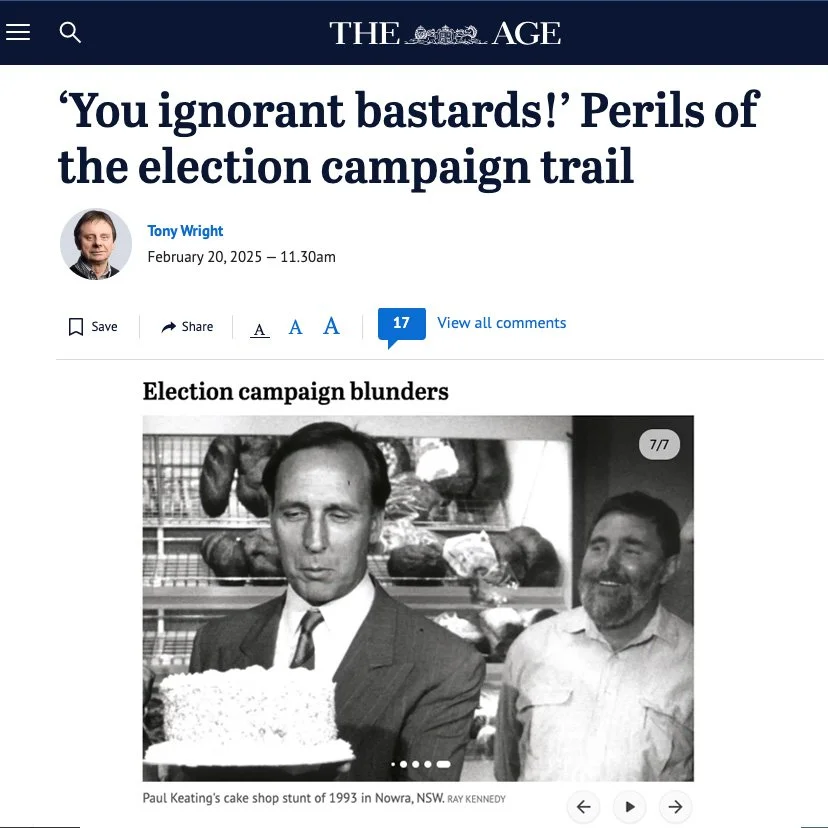
Tony has covered countless elections and is all set for the next one. Last week he readied readers for Election 2025, with an entertaining round-up of statements and stunts gone awry on past campaign trails.
A cold moon on a hot night: the cosmos abides beyond worldy horrors
After watching his veteran father plant it 90 years ago, John returns to a great elm at the Shrine
Before the internet we had copytakers. Stop. Break. Bless them all
Farewell Pete Steedman, a prankster and activist for the ages
The worm has turned: Whatever happened to the great election debates?
Time to get off the election campaign bus (and onto a motorbike)
Reports of the death of country newspapers are distinctly premature
Riding chill streets, listening for the lessons of Zen on a motorcycle
Spooked by artificial intelligence? It's song might surprise us
You learn a bit working on a local paper. It's all about the people
Sources & further reading
AI and journalism: What's next? | Reuters Institute for the Study of Journalism
Making Big Tech Pay for the News They Use | Centre for International Media Assistance
Major Canadian News Outlets Sue OpenAI In New Copyright Case - The New York Times
Media Companies Are Making a Huge Mistake With AI - The Atlantic
'The New York Times' takes OpenAI to court & ChatGPT's future could be on the line | NPR
What OpenAI’s deal with News Corp means for journalism (and for you) | The Conversation
I’m a freelance writer/strategist who shares complex concepts, ideas and insights along with stories from the extraordinary people behind them. If you’d like to work together, contact me.
